Preprocessing
Input conversion
- class astrocast.preparation.Input(logging_level=20)
Class for loading time series images and converting to an astroCAST compatible format.
- Parameters:
logging_level (
int(default:20)) – Sets the level at which information is logged to the console as an integer value. The built-in levels in the logging module are, in increasing order of severity: debug (10), info (20), warning (30), error (40), critical (50).
Example:
inp = Input()
inp.run('path/to/images', output_path='path/to/output.h5' channels=1, loc_out='data')
- run(input_path, output_path=None, sep='_', channels=1, z_slice=None, lazy=True, subtract_background=None, subtract_func='mean', rescale=None, dtype=<class 'int'>, in_memory=False, loc_in=None, loc_out='data', chunk_strategy='balanced', chunks=None, compression=None) ndarray | dict
Loads input data from a specified path, performs data processing, and optionally saves the processed data.
- Parameters:
input_path (
Union[str,Path]) – Path to the input file or directory.output_path (
Union[str,Path,None] (default:None)) – Path to save the processed data. If None, the processed data is returned.loc_in (
Optional[str] (default:None)) – Input dataset in the HDF5 file that is loaded.loc_out (
str(default:'data')) – Output dataset in the HDF5 file that is saved.z_slice (
Optional[Tuple[int,int]] (default:None)) – Selection of frames that are processed.sep (
str(default:'_')) – Separator used for sorting file names, [‘file_01.tiff’, ‘file_02.tiff’].channels (
Union[int,dict] (default:1)) – Number of channels or dictionary specifying channel names.subtract_background (
Union[str,ndarray,None] (default:None)) – Either channel name or array that is subtracted.subtract_func (
Union[Literal['mean','max','min','std'],Callable] (default:'mean')) – Function to use for background subtraction.rescale (
Union[float,Tuple[int,int],None] (default:None)) – Scale factor or tuple specifying the new dimensions.dtype (
type(default:<class 'int'>)) – Data type to convert the processed data.in_memory (
bool(default:False)) – If True, the processed data is loaded into memory.chunk_strategy (
Literal['balanced','XY','Z'] (default:'balanced')) – Strategy to use when inferring size of chunks.chunks (
Optional[Tuple[int,int,int]] (default:None)) – Chunk size to use when saving to HDF5 or TileDB.compression (
Optional[Literal['gzip','szip','lz4']] (default:None)) – Compression method to use when saving to HDF5 or TileDB.lazy (
bool(default:True)) – If True, the data is loaded on demand.
- Return type:
Union[ndarray,dict]
Motion correction
- class astrocast.preparation.MotionCorrection(working_directory=None, logging_level=20)
Class for performing motion correction based on the Jax-accelerated implementation of NoRMCorre.
- Parameters:
working_directory (
Union[str,Path,None] (default:None)) – Working directory for temporary files. If not provided, the temporary directory is created.logging_level (
int(default:20)) – Sets the level at which information is logged to the console as an integer value. The built-in levels in the logging module are, in increasing order of severity: debug (10), info (20), warning (30), error (40), critical (50).
Note
For more information see the accelerated (used here), original implementation and the associated publication Pnevmatikakis et al. 2017 [1]
Caution
Non-rigid motion correction is not always necessary. Sometimes, rigid motion correction will be sufficient, and it will lead to significant performance gains in terms of speed. Check your data before and after rigid motion correction to decide what is best (pw_rigid flag; see below).
Example:
mc = MotionCorrection()
mc.run('path/to/file.h5', loc='data/ch0')
mc.save(output='path/to/file.h5', loc='mc/ch0')
Footnotes
- run(path, loc='', max_shifts=(50, 50), niter_rig=3, splits_rig=14, num_splits_to_process_rig=None, strides=(48, 48), overlaps=(24, 24), pw_rigid=False, splits_els=14, num_splits_to_process_els=None, upsample_factor_grid=4, max_deviation_rigid=3, nonneg_movie=True, gSig_filt=(20, 20), bigtiff=True) None
Reduces motion artifacts by performing piecewise rigid motion correction.
- Parameters:
path (
Union[str,Path]) – The input data to be motion corrected.loc (
str(default:'')) – The dataset name in the .h5 file the data is stored in. Only relevant if path is an .h5 file.max_shifts (
Tuple[int,int] (default:(50, 50))) – A tuple specifying the maximum allowed rigid shift in pixels.niter_rig (
int(default:3)) – The maximum number of iterations for rigid motion correction. More iterations can improve motion correction quality, but increases runtime.splits_rig (
int(default:14)) – The number of splits to parallelize the motion correction for rigid correction.num_splits_to_process_rig (
Optional[int] (default:None)) – A list specifying the number of splits to process at each iteration for rigid correction.strides (
Tuple[int,int] (default:(48, 48))) – A tuple specifying the intervals at which patches are laid out for motion correction.overlaps (
Tuple[int,int] (default:(24, 24))) – A tuple specifying the overlaps between patches for motion correction.pw_rigid (
bool(default:False)) – A boolean indicating whether to perform piecewise or standard rigid motion correction.splits_els (
int(default:14)) – The number of splits to parallelize the motion correction for elastic correction.num_splits_to_process_els (
Optional[int] (default:None)) – A list specifying the number of splits to process at each iteration for elastic correction.upsample_factor_grid (
int(default:4)) – The upsample factor for the grid in elastic motion correction.max_deviation_rigid (
int(default:3)) – The maximum deviation from rigid motion allowed in pixels.nonneg_movie (
bool(default:True)) – A boolean indicating whether to enforce non-negativity in the motion corrected movie.gSig_filt (
Tuple[int,int] (default:(20, 20))) – A tuple specifying the size of the Gaussian filter for filtering the movie.bigtiff (
bool(default:True)) – A boolean indicating whether to save the motion corrected movie as a BigTIFF file. Prevents errors when correcting videos dimensions exceeding the capabilities of the standard tiff format.
- Return type:
None
- save(output=None, loc='mc/ch0', chunk_strategy='balanced', chunks=None, compression=None, remove_intermediate=True) ndarray | None
Retrieve the motion-corrected data and optionally save it to a file.
- Parameters:
output (
Union[str,Path,None] (default:None)) – Output file path where the data should be saved.loc (
str(default:'mc/ch0')) – Location within the HDF5 file to save the data (required when output is an HDF5 file).chunk_strategy (
Literal['balanced','XY','Z'] (default:'balanced')) – Chunk strategy to use when saving to an HDF5 file.chunks (
Optional[Tuple[int,int,int]] (default:None)) – Chunk shape for creating a dask array when saving to an HDF5 file.compression (
Optional[Literal['gzip','lzf','szip']] (default:None)) – Compression algorithm to use when saving to an HDF5 file.remove_intermediate (
bool(default:True)) – Whether to remove the intermediate files associated with motion correction after retrieving the data.
- Return type:
Optional[ndarray]
Notes
This method should be called after motion correction is completed by using the run() function.
If output is specified, the motion-corrected data is saved to the specified file using the IO class.
If remove_intermediate is set to True, the mmap file associated with motion correction is deleted after retrieving the data.
Denoising
- class astrocast.denoising.SubFrameGenerator(paths, batch_size, input_size=(100, 100), pre_post_frame=5, gap_frames=0, z_steps=0.1, z_select=None, allowed_rotation=[0], allowed_flip=[-1], random_offset=False, add_noise=False, drop_frame_probability=None, max_per_file=None, overlap=0, padding=None, shuffle=True, normalize=None, loc='data/', output_size=None, cache_results=False, in_memory=False, save_global_descriptive=True, logging_level=20)
Generates batches of preprocessed data from video files for neural network training.
This class is designed to work with video data stored in .h5 files in (Z, X, Y) format. It supports various preprocessing options including cropping, rotation, flipping, adding noise, and normalizing data. The class can handle single or multiple data paths, and it is capable of generating batches of a specified input size.
- Parameters:
paths (
Union[str,List[str]]) – Path(s) to .h5 file(s) containing video data.batch_size (
int) – The size of the data batches.input_size (
Tuple[int,int] (default:(100, 100))) – The size of each input frame.pre_post_frame (
Union[int,Tuple[int,int]] (default:5)) – Number of frames before and after the central frame to consider.gap_frames (
Union[int,Tuple[int,int]] (default:0)) – Number of frames to skip before and after each central frame.z_steps (
float(default:0.1)) – The step size in the z-direction.z_select (
Union[None,int,List[int]] (default:None)) – Criteria for selecting a subset of frames.allowed_rotation (
List[int] (default:[0])) – Allowed rotation angles. Set to [0] to prevent rotation.allowed_flip (
List[int] (default:[-1])) – Allowed flip operations. Set to [-1] to prevent flipping.random_offset (
bool(default:False)) – If True, applies random offset.add_noise (
bool(default:False)) – If True, adds noise to the data.drop_frame_probability (
Optional[float] (default:None)) – Probability of dropping a frame.max_per_file (
Optional[int] (default:None)) – Maximum data to consider per file.overlap (
int(default:0)) – Overlap between consecutive frames.padding (
Optional[Literal['symmetric','edge']] (default:None)) – Type of padding to apply.shuffle (
bool(default:True)) – If True, shuffles the data.normalize (
Optional[Literal['local','global']] (default:None)) – Normalization mode.loc (
str(default:'data/')) – Dataset name in the .h5 file.output_size (
Optional[Tuple[int,int]] (default:None)) – The size of the output data.cache_results (
bool(default:False)) – If True, caches the results.in_memory (
bool(default:False)) – If True, keeps data in memory, which can speed up processing but might lead to memory leaks.save_global_descriptive (
bool(default:True)) – If True, saves global descriptive statistics to the .h5 file preventing computation of the same value on subsequent runs.logging_level (
int(default:20)) – The logging level.
- Raises:
AssertionError – If input conditions related to rotation, padding, or normalization are not met.
ValueError – If ‘random_offset’ and ‘overlap’ are set simultaneously.
Example:
# Create a SubFrameGenerator instance
generator = SubFrameGenerator(paths="path/to/data.h5", loc="data/ch0",
    batch_size=32, input_size=(128, 128), pre_post_frame=5,
    shuffle=True, normalize="global"
)
- infer(model, output=None, out_loc=None, dtype='same', chunk_size=None, rescale=True) ndarray | Path | None
Performs inference on video data using a provided model and generates output in specified format.
This method applies a deep learning model to the video data to perform tasks such as denoising or segmentation. It supports different input and output formats, including .h5 and .tif files. The method also allows for optional rescaling of the output and handles data chunking for efficient processing.
- Raises:
FileNotFoundError – If the model file or directory cannot be found.
ValueError – If ‘random_offset’ and ‘overlap’ are set simultaneously or incompatible arguments are provided.
AssertionError – If provided ‘model’ is not of the expected type or if data dimensions mismatch.
- Parameters:
model (
Union[Model,str,Path]) – A Keras model or the path to a model file/directory for inference.output (
Union[str,Path,None] (default:None)) – Path to the file where the output will be saved. If None, the output array is returned.out_loc (
Optional[str] (default:None)) – Location within the .h5 file to store the output. Required if output is an .h5 file.dtype (
Union[Literal['same'],dtype] (default:'same')) – Data type of the output. ‘same’ uses the same dtype as the input data.updated (# TODO chunk_size should probably be) –
chunk_size (
Union[str,Tuple[int,int,int],None] (default:None)) – Size of chunks for .h5 file output. Can be ‘infer’, an integer, or None.rescale (
bool(default:True)) – Whether to rescale the output based on global descriptive statistics.
- Return type:
Union[ndarray,Path,None]- Returns:
Depending on ‘output’, either a numpy array of the processed data, a Path object pointing to the saved file, or None.
Example:
# Assuming a SubFrameGenerator instance 'generator' and a Keras model 'model'
output_data = generator.infer(model, output="output_path.h5",
    out_loc="inference_results", dtype="float32")
- on_epoch_end()
Method called at the end of every epoch.
- class astrocast.denoising.Network(train_generator, val_generator=None, learning_rate=0.001, decay_rate=0.99, decay_steps=250, n_stacks=3, kernel=64, batchNormalize=False, loss='annealed_loss', pretrained_weights=None, use_cpu=False)
A neural network class designed for image processing tasks, typically utilizing U-Net architecture.
This class facilitates the creation, training, and evaluation of a U-Net based neural network model. It is equipped to handle training with custom generators, various configurations for the model architecture, and supports multiple loss functions. The class is designed to be flexible and adaptable for a wide range of image processing tasks.
- Parameters:
train_generator (
SubFrameGenerator) – ASubFrameGeneratorobject for training data.val_generator (
Optional[SubFrameGenerator] (default:None)) – ASubFrameGeneratorobject for validation data, used for evaluating model performance during training.learning_rate (
float(default:0.001)) – Initial learning rate for the optimizer.decay_rate (
float(default:0.99)) – Decay rate for learning rate reduction over training epochs.decay_steps (
int(default:250)) – Number of steps after which the learning rate decays.n_stacks (
int(default:3)) – Number of stacks (or depth) in the U-Net model.kernel (
int(default:64)) – The number of filters in the initial convolution layer of the U-Net model.batchNormalize (
bool(default:False)) – Flag to enable or disable batch normalization in the model.loss (
Union[Literal['annealed_loss','mean_squareroot_error'],Loss] (default:'annealed_loss')) – The loss function used for model training. Supports custom loss functions.pretrained_weights (
Union[str,Path,None] (default:None)) – Path to the pretrained weights for model initialization.use_cpu (
bool(default:False)) – Flag to enforce training on CPU, useful in GPU-constrained environments.
- Raises:
FileNotFoundError – If the provided model path does not exist or is invalid.
ValueError – If incompatible arguments are provided.
AssertionError – For invalid input conditions related to the model configuration.
Example:
from astrocast.denoising import SubFrameGenerator, Network

# Creating an instance of the Network class
train_gen = SubFrameGenerator("/path/to/train/data")
val_gen = SubFrameGenerator("/path/to/val/data")
net = Network(train_gen, val_gen, learning_rate=0.001, n_stacks=3, kernel=64)
- static annealed_loss(y_true, y_pred) Tensor
Calculates the annealed loss between the true and predicted values.
- Parameters:
y_true (Union[tf.Tensor, np.ndarray]) – The true values.
y_pred (Union[tf.Tensor, np.ndarray]) – The predicted values.
- Returns:
The calculated annealed loss.
- Return type:
tf.Tensor
- static mean_squareroot_error(y_true, y_pred) Tensor
Calculates the mean square root error between the true and predicted values.
- Parameters:
y_true (Union[tf.Tensor, np.ndarray]) – The true values.
y_pred (Union[tf.Tensor, np.ndarray]) – The predicted values.
- Returns:
The calculated mean square root error.
- Return type:
tf.Tensor
- retrain_model(frozen_epochs=25, unfrozen_epochs=5, batch_size=10, patience=3, min_delta=0.005, monitor='val_loss', save_model=None, model_prefix='retrain', verbose=1)
Retrains the model with a new dataset, employing a two-phase training process with frozen and unfrozen layers.
In the first phase, the model is trained with its internal layers frozen, allowing only the final layers to adjust. In the second phase, all layers are unfrozen for additional training. This method is particularly useful when adapting a pre-trained model to new data, leveraging transfer learning.
- Parameters:
frozen_epochs (
int(default:25)) – Number of epochs to train with frozen layers.unfrozen_epochs (
int(default:5)) – Number of epochs to train after unfreezing all layers.batch_size (
int(default:10)) – Number of samples per gradient update.patience (
int(default:3)) – Number of epochs with no improvement after which training will be stopped.min_delta (
float(default:0.005)) – Minimum change in the monitored quantity to qualify as an improvement.monitor (
str(default:'val_loss')) – Quantity to be monitored during training.save_model (
Union[str,Path,None] (default:None)) – Directory to save the retrained model and checkpoints.model_prefix (
str(default:'retrain')) – Prefix for naming saved model files.verbose (
int(default:1)) – Verbosity mode (0 - silent, 1 - progress bar, 2 - one line per epoch).
Example:
# Assuming an instance 'net' of the Network class
net.retrain_model(frozen_epochs=20, unfrozen_epochs=10, batch_size=32, save_model='./retrain_model_save')
- run(batch_size=10, num_epochs=25, save_model=None, patience=3, min_delta=0.005, monitor='val_loss', model_prefix='model', verbose=1) History
Trains the neural network model using the provided data generators and specified parameters.
This method facilitates the training of the model with features like early stopping, model checkpointing, and verbose output control. It is designed to offer flexibility in training configuration, allowing for customization of batch size, number of epochs, and other key training parameters. The method is well-suited for training deep learning models in tasks that require iterative learning and model evaluation.
- Parameters:
batch_size (
int(default:10)) – Number of samples per gradient update.num_epochs (
int(default:25)) – Number of epochs to train the model.patience (
int(default:3)) – Number of epochs with no improvement after which training will be stopped.min_delta (
float(default:0.005)) – Minimum change in the monitored quantity to qualify as an improvement.monitor (
str(default:'val_loss')) – Quantity to be monitored during training.save_model (
Union[str,Path,None] (default:None)) – Directory to save the model and checkpoints.model_prefix (
str(default:'model')) – Prefix for naming saved model files.verbose (
int(default:1)) – Verbosity mode (0 - silent, 1 - progress bar, 2 - one line per epoch).
- Return type:
History- Returns:
A History object containing the training history metrics.
Example:
# Assuming an instance 'net' of the Network class
history = net.run(batch_size=32, num_epochs=100, save_model='./model_save', verbose=1)
print(history.history)
Bleach correction
- class astrocast.preparation.Delta(data, loc='')
Provides methods for bleach correction of input data.
- Parameters:
data (
Union[str,Path,ndarray,Array]) – The input data to be processed.loc (
str(default:'')) – The location of the data in the HDF5 file. This parameter is optional and only applicable when data has the .h5 extension.
Example:
delta = Delta('/path/to/input.h5', loc="data/ch0")
delta.run(window=10, method="dF")
delta.save(output_path='/path/to/input.h5', loc="df/ch0", chunk_strategy="balanced", compression="gzip")
- run(window, method='dF', chunk_strategy='Z', chunks=None, overwrite_first_frame=True) ndarray | Array
Performs bleach correction on the input data using specified methods and parameters.
- Parameters:
window (
int) – The size of the window for the minimum filter.method (
Literal['background','dF','dFF'] (default:'dF')) – The method to use for delta calculation.chunk_strategy (
Literal['balanced','XY','Z'] (default:'Z')) – Strategy to infer appropriate chunk sizechunks (default:
None) – User-defined chunk size (ignores inference strategy).overwrite_first_frame (
bool(default:True)) – A flag indicating whether to overwrite the values of the first frame with the second frame after delta calculation.
- Raises:
ValueError – If the input data type is not recognized.
- Return type:
Union[ndarray,Array]
Notes
The function supports different types of input data, including numpy arrays, file paths (specifically .tdb and .h5 files), and Dask arrays. It also handles parallel execution for large datasets, especially when input is a .tdb file.
Warning
For .tdb files as input, this function will overwrite the provided file.
- save(output_path, loc='df', chunk_strategy='balanced', chunks=None, compression=None, overwrite=False)
Saves the result data to a specified file.
This method wraps the functionality of the IO class’s save method, allowing for saving the data in different chunk strategies and with various compression methods.
- Parameters:
output_path (
Union[str,Path]) – Path to the file where the data will be saved.loc (
str(default:'df')) – The dataset name within the HDF5 file to store the data.chunk_strategy (
Literal['balanced','XY','Z'] (default:'balanced')) – Strategy to infer appropriate chunk size when saving.chunks (
Optional[Tuple[int,int,int]] (default:None)) – User-defined chunk size. Ignores chunk_strategy.compression (
Optional[Literal['gzip','szip','lz4']] (default:None)) – Compression method to use for storing the data.overwrite (
bool(default:False)) – Whether to overwrite the file if it already exists.
Note
The ‘loc’ parameter defaults to ‘df’, and the ‘chunk_strategy’ defaults to ‘balanced’. If ‘chunks’ is not specified, the method will infer appropriate chunk sizes based on the strategy. The ‘overwrite’ flag is set to False by default, ensuring that existing files are not overwritten unless explicitly intended.
Event detection
- class astrocast.detection.Detector(input_path, output=None, logging_level=20)
Detector is a class designed for detecting and analyzing astrocytic events in video datasets, particularly focusing on spatial and temporal characteristics of these events.
The class implements a robust event detection algorithm that leverages both spatial and temporal data to identify astrocytic events. The algorithm can be tuned using various parameters to adapt to different datasets and research needs.
- Key Features:
Gaussian Smoothing: Enhances events while preserving spatial features. Can be adjusted or omitted based on the dataset.
Spatial Thresholding: Utilizes mean fluorescence ratios to differentiate active areas from background, considering the whole frame.
Temporal Thresholding: Treats the video as a series of 1D time series, identifying active pixels by peak prominence and other characteristics.
Morphological Operations: Corrects for potential artifacts in thresholding, like filling holes or removing noise-based objects.
Event Separation: An experimental feature to split closely occurring events for finer analysis.
Attention
Caveats
Parameter Sensitivity: The effectiveness of event detection is highly dependent on the choice of parameters, which may need tuning for different datasets.
Smoothing Impact: Temporal thresholding is sensitive to the smoothing applied, requiring careful adjustment of smoothing parameters.
Noise and Artifacts: The algorithm includes provisions for noise adjustment and artifact removal, but these may not cover all types of dataset-specific noise.
Parallel Processing: Default parallel processing can be toggled off for troubleshooting but may affect performance.
The method run executes the event detection process and returns the path to the directory containing the results and metadata. It saves all provided arguments for traceability and reproducibility of the analysis.
- Parameters:
input_path (
Union[str,Path]) – Path to the input file.output (
Union[str,Path,None] (default:None)) – Path to the output directory. If None, the output directory is created in the input directory.logging_level (
int(default:20)) – Sets the level at which information is logged to the console as an integer value. The built-in levels in the logging module are, in increasing order of severity: debug (10), info (20), warning (30), error (40), critical (50).
Example:
detector = astrocast.detection.Detector(input_path=/path/to/preprocessed/video)
detector.run(loc='df/ch0')
- characterize_event(event_id, t0, t1, data_info, event_info, out_path, split_events=True, use_on_disk_sharing=False) int | None
Characterizes an event by computing various properties and metrics.
This function analyzes a specific event in a dataset by calculating properties such as bounding box dimensions, area, shape, and signal traces. It supports handling split events and saves the results to a specified path.
- Parameters:
event_id (
int) – The unique identifier of the event to characterize.t0 (
int) – The starting time index for the event.t1 (
int) – The ending time index for the event.data_info (
Tuple[Sequence[int],dtype,str]) – Information about the data, including shape and type.event_info (
Tuple[Sequence[int],dtype,str]) – Information about the event, including shape and type.out_path (
Union[str,Path]) – The path where the results will be saved.split_events (
bool(default:True)) – Flag to determine if events should be split.use_on_disk_sharing (
bool(default:False)) – Flag to toggle between on-disk (mmap) and in-RAM (shared memory) methods.
Warning
The use_on_disk_sharing parameter enables the use of on-disk memory mapping (mmap) instead of in-RAM shared memory. While this method ensures compatibility in environments where in-RAM sharing (e.g., Docker containers) may cause crashes, it is generally slower due to disk I/O operations. Use this method if you encounter issues with shared memory, particularly in containerized environments.
Note
Event Properties Explained Property
Brief Description
In-Depth Explanation & Formula
z0, z1
Z-index bounds
Start (z0) and end (z1) indices in the z-dimension.
x0, x1, y0, y1
XY bounding box
Coordinates defining the bounding box in x (x0, x1) and y (y0, y1) dimensions.
dz, dx, dy
Bounding box size
Dimensions of the bounding box: depth (dz), width (dx), and height (dy).
v_length
Event length
Length of the event in the z-dimension. Calculated as
 .
.v_diameter
Event diameter
Diameter of the event. Calculated as
 .
.v_area
Event area
Total area covered by the event. Calculated as the count of z-indices where event_id is present.
v_bbox_pix_num
Bounding box pixel count
Total number of pixels within the bounding box. Calculated as :math:` dz * dx * dy `.
mask
Event mask
Binary mask indicating the presence (1) or absence (0) of the event.
v_mask_centroid_local
Local centroid
The local centroid coordinates of the event mask. Calculated for each dimension and normalized by the size of the bounding box in the respective dimension. Formula:
 corresponding to z, x, y dimensions.
v_mask_axis_major_length
Major axis length
The length of the major axis of the ellipse that has the same normalized second central moments as the region. ???
v_mask_axis_minor_length
Minor axis length
The length of the minor axis of the ellipse that has the same normalized second central moments as the region. ???
v_mask_extent
Extent
The ratio of pixels in the region to pixels in the total bounding box. Calculated as
 .
.v_mask_solidity
Solidity
The proportion of the pixels in the convex hull that are also in the region. Calculated as
 . ???
. ???v_mask_area
Area
The number of pixels in the region.
v_mask_equivalent_diameter_area
Equivalent diameter
The diameter of a circle with the same area as the region. Calculated as
 .
.contours
Event contours
Contours extracted from each frame of the event. ???
footprint
2D event footprint
The 2D representation of the event, capturing its extent in the XY plane.
v_fp_<property>
Footprint properties
Properties such as centroid, eccentricity, perimeter calculated from the 2D footprint. ???
trace
Signal trace
The average signal intensity of the event across the z-dimension.
v_max_height
Maximum trace height
The peak signal intensity in the trace. Calculated as
 .
.v_max_gradient
Maximum trace gradient
The steepest gradient in the trace. Calculated as
 .
.noise_mask_trace
Noise mask trace
The trace calculated from the noise mask area. ???
v_noise_mask_mean
Noise mean
The mean value of the noise mask trace. Calculated as
 .
.v_noise_mask_std
Noise standard deviation
The standard deviation of the noise mask trace. Calculated as
 .
.v_signal_to_noise_ratio
Signal-to-noise ratio
Ratio of signal intensity to noise. Calculated as
 .
.v_signal_to_noise_ratio_fold
Signal-to-noise fold change
Signal-to-noise ratio adjusted for noise standard deviation. Calculated as
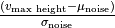 .
.error
Error flag
Indicates any computational errors during property calculation. 0 for no error, 1 for error.
- Return type:
Optional[int]- Returns:
An integer indicating the status (e.g., 2 for existing results) or None if the process completes.
- static cleanup_mmap(file_path)
Closes the memory-mapped object and deletes the associated file.
- Parameters:
mmap_obj – The memory-mapped object to be closed.
file_path – The file path of the memory-mapped file.
- run(loc=None, exclude_border=0, threshold=None, use_smoothing=True, smooth_radius=2, smooth_sigma=2, use_spatial=True, spatial_min_ratio=1, spatial_z_depth=1, use_temporal=True, temporal_prominence=10, temporal_width=3, temporal_rel_height=0.9, temporal_wlen=60, temporal_plateau_size=None, comb_type='&', fill_holes=True, area_threshold=10, holes_connectivity=1, holes_depth=1, remove_objects=True, min_size=20, object_connectivity=1, objects_depth=1, fill_holes_first=True, lazy=True, adjust_for_noise=False, z_slice=None, split_events=False, debug=False, event_map_export_format='.tiff', parallel=True, use_on_disk_sharing=False) Path
Executes the AstroCAST event detection algorithm on a specified video dataset.
- Parameters:
loc (
Optional[str] (default:None)) – Identifier of the dataset within an HDF5 file.exclude_border (
int(default:0)) – Exclude the border pixels to mitigate motion correction artifacts.threshold (
Union[int,float,None] (default:None)) – Absolute value for simple thresholding; uses automatic thresholding if None.use_smoothing (
bool(default:True)) – Apply Gaussian smoothing to enhance events while preserving spatial features.smooth_radius (
int(default:2)) – Radius for the Gaussian smoothing kernel.smooth_sigma (
int(default:2)) – Sigma value for the Gaussian smoothing kernel.use_spatial (
bool(default:True)) – Enable spatial thresholding based on the mean fluorescence ratio.spatial_min_ratio (
Union[int,float] (default:1)) – Minimum ratio of active to inactive pixels for spatial thresholding.spatial_z_depth (
int(default:1)) – Number of frames considered for automatic spatial thresholding.use_temporal (
bool(default:True)) – Enable temporal thresholding to identify active pixels in timeseries.temporal_prominence (
Union[int,float] (default:10)) – Minimum prominence of peaks for temporal thresholding.temporal_width (
int(default:3)) – Minimum width of peaks to exclude short-duration noise.temporal_rel_height (
Union[int,float] (default:0.9)) – Defines boundaries of events relative to peak height.temporal_wlen (
int(default:60)) – Window length for prominence calculation in temporal thresholding.temporal_plateau_size (
Optional[int] (default:None)) – Minimum size of a plateau to be considered an event.comb_type (
Literal['&','|'] (default:'&')) – Combination type for spatial and temporal thresholding (’&’ or ‘|’).fill_holes (
bool(default:True)) – Apply morphological operations to fill holes in detected events.area_threshold (
int(default:10)) – Maximum size of holes to be filled.remove_objects (
bool(default:True)) – Apply morphological operations to remove small objects.objects_depth (
int(default:1)) – Number of frames considered for automatic object removal.min_size (
int(default:20)) – Minimum size of an event region for inclusion in the results.holes_depth (
int(default:1)) – Number of frames considered for automatic temporal thresholding.holes_connectivity (
int(default:1)) – Modifies shape of the element used to fill holes.object_connectivity (
int(default:1)) – Modifies shape of the element used to remove small objects.fill_holes_first (
bool(default:True)) – Determines whether holes are filled before removing small objects.lazy (
bool(default:True)) – Implement lazy loading of data for efficient memory usage.adjust_for_noise (
bool(default:False)) – Adjust event detection for background noise, used with threshold.z_slice (
Optional[Tuple[int,int]] (default:None)) – Selection of frames that are processed.split_events (
bool(default:False)) – Experimental feature to split incorrectly connected events.event_map_export_format (
Literal['.tiff','.h5','.tdb'] (default:'.tiff')) – Suffix of the output file for the event map.debug (
bool(default:False)) – Enable debug mode to export intermediary steps for troubleshooting.parallel (
bool(default:True)) – Enable parallel execution for event characterization.use_on_disk_sharing (default:
False) – Flag to toggle between on-disk (mmap) and in-RAM (shared memory) methods.
- Return type:
Path
Warning
The use_on_disk_sharing parameter enables the use of on-disk memory mapping (mmap) instead of in-RAM shared memory. While this method ensures compatibility in environments where in-RAM sharing (e.g., Docker containers) may cause crashes, it is generally slower due to disk I/O operations. Use this method if you encounter issues with shared memory, particularly in containerized environments.
Note
Smoothing parameters (sigma and radius) enhance events while preserving spatial features.
Spatial and temporal thresholding classify pixels as active, potentially belonging to astrocytic events.
Outputs include the event map, time map, and metadata, saved in specified formats.
Debug mode is useful for troubleshooting unsatisfactory event detection results.
The event object
- class astrocast.analysis.Events(event_dir, lazy=True, data=None, loc=None, group=None, subject_id=None, z_slice=None, index_prefix=None, custom_columns=('v_area_norm', 'cx', 'cy'), frame_to_time_mapping=None, frame_to_time_function=None, cache_path=None, seed=1)
The Events class manages and processes astrocytic events detected in timeseries calcium recordings. It provides various functionalities such as loading, extending, filtering, and analyzing events.
- Parameters:
event_dir (
Union[str,Path]) – The directory or list of directories where event data is stored after event detection.lazy (
bool(default:True)) – Flag to indicate if data should be loaded lazily.data (
Union[ndarray,Array,str,Path,None] (default:None)) – The associated video data or path to it. If set to infer, attempts to automatically determine the video path.loc (
Optional[str] (default:None)) – Location specification for loading data, applicable when data is a .h5 file.group (
Union[str,int,None] (default:None)) – Identifier for the group or condition to which the events belong.subject_id (
Union[str,int,None] (default:None)) – Identifier for the subject associated with the events.z_slice (
Optional[Tuple[int,int]] (default:None)) – The frame range to consider for processing.index_prefix (
Optional[str] (default:None)) – Prefix for indexing events. Useful in multi-file scenarios.custom_columns (
Union[list,Tuple,Literal['v_area_norm','v_ara_footprint','cx','cy']] (default:('v_area_norm', 'cx', 'cy'))) – Additional columns to compute and include in the events DataFrame.frame_to_time_mapping (
Union[dict,list,None] (default:None)) – Mapping from frame numbers to absolute time.frame_to_time_function (
Union[Callable,list,None] (default:None)) – Function to convert frame numbers to absolute time.cache_path (
Union[str,Path,None] (default:None)) – Path for caching processed data.seed (
int(default:1)) – Seed value for hash generation. Needs to stay consistent between runs of analysis for caching to work.
- Features:
Load and preprocess event data from specified directories.
Supports both single and multiple file loading.
Extend event traces in time by their mean or edge footprint.
Normalize and filter events based on specified criteria.
Generate and visualize summary statistics, frequency distributions, and clustering results.
Example:
from astrocast.analysis import Events
event_obj = Events('/your/event/dir')
- add_clustering(cluster_lookup_table, column_name='cluster') None
Adds a clustering column to the events DataFrame based on a provided lookup table.
This method maps each event to a cluster label using the provided cluster_lookup_table and adds these labels as a new column in the events DataFrame. If the specified column name already exists in the DataFrame, it will be overwritten.
- Parameters:
cluster_lookup_table (
dict) – A dictionary mapping event indices to cluster labels. The keys should correspond to the indices of the events DataFrame, and the values should be the assigned cluster labels.column_name (
str(default:'cluster')) – The name of the column to add to the events DataFrame. This column will contain the cluster labels. If a column with this name already exists, it will be overwritten.
- Raises:
Warning – If the specified column_name already exists in the events DataFrame, a warning is raised, and the existing column is overwritten.
- Return type:
None
Example:
import numpy as np
from astrocast.analysis import Events

event_obj = Events('/path/to/events/dir')
random_lookup_table = {i: np.random.randint(0, 5) for i in event_obj.events.index.tolist()}

events.add_clustering(random_lookup_table, column_name="random_labels")
- copy()
Returns a copy of the Events object.
- static create_event_map(events, video_dim, dtype=<class 'int'>, show_progress=True, save_path=None) ndarray | Array
Recreate the event map from the events DataFrame.
- Parameters:
events (
DataFrame) – The events DataFrame containing the ‘mask’ column.video_dim (
Tuple[int,int,int]) – The dimensions of the video in the format (num_frames, width, height).dtype (
type(default:<class 'int'>)) – The data type of the event map.show_progress (
bool(default:True)) – Specifies whether to show a progress bar.save_path (
Union[str,Path,None] (default:None)) – The file path to save the event map.
- Returns:
The created event map.
- Return type:
ndarray
- Raises:
ValueError – If ‘mask’ column is not present in the events DataFrame.
- create_lookup_table(labels, default_cluster=-1) Dict[int, int]
Creates a lookup table mapping event indices to cluster labels.
This function generates a dictionary that serves as a lookup table, mapping each event index to a corresponding cluster label. It utilizes a defaultdict, setting a default cluster label for any index not explicitly provided in ‘labels’.
- Parameters:
labels (
List[int]) – A list of cluster labels corresponding to each event.default_cluster (
int(default:-1)) – The default cluster label for any event not found in ‘labels’.
- Return type:
Dict[int,int]- Returns:
A dictionary serving as a lookup table for cluster labels.
Example:
# Assuming a class instance 'events_obj' and a list of labels 'event_labels'
lookup_table = events_obj.create_lookup_table(event_labels)
print(lookup_table)
- enforce_length(min_length=None, pad_mode='edge', max_length=None, inplace=False) DataFrame
Adjusts the length of each event trace in a DataFrame to meet specified minimum and/or maximum length requirements.
This method modifies the lengths of event traces by either padding them to meet a minimum length or truncating them to adhere to a maximum length. It’s particularly useful in standardizing the size of events for consistent analysis. The method supports different padding modes and can operate in place or return a modified copy.
Caution
‘z0’ and ‘z1’ values in the events DataFrame do not correspond to the adjusted event boundaries after this operation.
- Parameters:
min_length (
Optional[int] (default:None)) – The minimum length to ensure for each event trace. If None, no minimum length enforcement is done.pad_mode (
str(default:'edge')) – The padding mode to use if padding is necessary (‘constant’, ‘edge’, etc.). Default is ‘edge’.max_length (
Optional[int] (default:None)) – The maximum length to allow for each event trace. If None, no maximum length enforcement is done.inplace (
bool(default:False)) – If True, modifies the ‘events’ attribute of the object in place.
- Return type:
DataFrame- Returns:
A DataFrame with the adjusted event traces. The original DataFrame is modified if ‘inplace’ is True.
Example:
# Assuming a class instance 'event_obj'
modified_events = event_obj.enforce_length(min_length=100, max_length=200, pad_mode='constant', inplace=False)
print(modified_events)
- filter(filters, inplace=True) None | DataFrame
Filters the events DataFrame based on specified criteria.
This method applies filtering on the events DataFrame based on the criteria provided in the filters dictionary. The filtering can be done either in place or on a copy of the DataFrame, depending on the inplace parameter.
- Parameters:
filters (
dict) – A dictionary where keys are column names and values are tuples specifying the filtering criteria. For numeric columns, the tuple should be (min_value, max_value). For string or categorical columns, the tuple should contain the allowed values.inplace (bool) – If True, the filtering is applied in place and the method returns None. If False, a new DataFrame with the filtered data is returned.
- Return type:
Optional[DataFrame]- Returns:
If inplace is False, returns the filtered DataFrame. Otherwise, returns None.
- Raises:
ValueError – If an unknown column data type is encountered.
Example:
# Assuming `events` is an instance of the Events class
# To filter events where the event length is between 5 and 20 frames use:
filters = {'dz': (5, 20)}
filtered_events = events.filter(filters, inplace=False)
- get_counts_per_cluster(cluster_col, group_col=None) DataFrame
Computes the counts of events per cluster, optionally grouped by an additional column.
This method calculates the frequency of events in each cluster. If a group column is provided, it calculates the frequency of events in each cluster for each group.
- Parameters:
cluster_col (
str) – The name of the column in the events DataFrame that contains cluster labels.group_col (
Optional[str] (default:None)) – The name of the column by which to group counts. If provided, the method returns counts per cluster for each group. If None, the method returns overall counts per cluster.
- Returns:
A DataFrame with counts of events. Each row represents a cluster. If group_col is provided, each column represents a group, otherwise there is a single column with total counts.
- Return type:
pd.DataFrame
Note
This method is particularly useful for analyzing the distribution of events across different clusters and groups.
- static get_event_map(event_dir, z_slice=None, lazy=True) Tuple[ndarray | Array, list | tuple | ndarray, type] | Tuple[None, None, None]
Retrieve the event map from the specified directory, as well as its shape and data type.
- Parameters:
event_dir (
Union[str,Path]) – The directory path where the event map is located.z_slice (
Optional[Tuple[int,int]] (default:None)) – The frame range to consider for loading.lazy (
bool(default:True)) – Specifies whether to load the event map lazily.
- Return type:
Union[Tuple[Union[ndarray,Array],Union[list,tuple,ndarray],type],Tuple[None,None,None]]
- normalize(normalize_instructions, inplace=True) None | ndarray
Normalizes the event traces based on provided normalization instructions.
This method applies normalization operations to the traces of events. It supports multiple normalization strategies defined in ‘normalize_instructions’. The normalization can be done either in place or return the normalized traces without altering the original data. Useful in data preprocessing, especially in signal processing or time-series analysis.
- Parameters:
normalize_instructions (
dict) – A dictionary containing normalization instructions. Seerun()for more details.inplace (
bool(default:True)) – If True, updates the ‘events.trace’ in place. Otherwise, returns the normalized traces.
- Return type:
Optional[ndarray]- Returns:
None if ‘inplace’ is True; otherwise, returns a numpy array of normalized traces.
Example:
# Assuming a class instance 'event_obj'
norm_instr = { 0: ["subtract", {"mode":"min"}], 1: ["divide", {"mode": "max"}]
normalized_traces = event_obj.normalize(norm_instr, inplace=False)
print(normalized_traces)
- plot_cluster_counts(counts, normalize_instructions=None, method='average', metric='euclidean', z_score=0, center=0, transpose=False, color_palette='viridis', group_cmap=None, cmap='vlag') Tuple[ClusterGrid, dict]
Creates and returns a seaborn cluster map for the given counts DataFrame, along with clustering quality scores.
This method generates a cluster map (heatmap with hierarchical clustering) based on the provided counts DataFrame generated with
get_counts_per_cluster(). The counts can optionally be normalized. The method also calculates clustering quality scores.- Parameters:
counts (
DataFrame) – A DataFrame where rows represent clusters and columns represent groups. Each cell contains the count of events for that cluster-group pair.normalize_instructions (
Optional[dict] (default:None)) – Instructions for normalization of counts. Seerun()for more information.method (
str(default:'average')) – Linkage method for hierarchical clustering. See seaborn.clustermap for more information.metric (
str(default:'euclidean')) –Distance metric for hierarchical clustering. See seaborn.clustermap for more information.
z_score (
Literal[0,1,None] (default:0)) – Whether to standardize (z-score normalize) rows (1), columns (0), or neither (None).center (
Union[int,float] (default:0)) – Value at which to center the data during normalization.transpose (
bool(default:False)) – Whether to transpose the counts DataFrame before plotting.color_palette (
str(default:'viridis')) – Color palette name for generating group colors if group_cmap is ‘auto’. See seaborn color palettes for a selection of available palettes.group_cmap (
Union[str,dict,Literal['auto'],None] (default:None)) – Color mapping for groups. If ‘auto’, colors are assigned based on the color_palette. If None, no group colors are used.cmap (
str(default:'vlag')) – Colormap for the heatmap. See matplotlib colormaps for a selection of available color maps.
- Returns:
A tuple containing the seaborn ClusterGrid object and a dictionary of clustering quality scores.
- Return type:
Tuple[sns.matrix.ClusterGrid, dict]
- show_event_map(video=None, loc=None, z_slice=None, lazy=True)
Visualizes the event map and associated video data using the napari viewer.
This method opens a napari viewer and displays the video data alongside various debug files and the event map. It allows for an interactive exploration of the event data in the context of the original video and processed debug data. If the video data is not provided, it attempts to load it from the path specified during the initialization of the class instance.
- Parameters:
video (
Union[str,Path,None] (default:None)) – Path to the video file to be displayed. If None, the method attempts to load the video from the path provided during the class instance initialization.loc (
Optional[str] (default:None)) – Location parameter for loading the video data. Only relevant if the video data is loaded from a path.z_slice (
Optional[Tuple[int,int]] (default:None)) – A tuple specifying the z-slice range of the data to be visualized.lazy (
bool(default:True)) – If True, loads the video data lazily (useful for large datasets), but slows down visualization.
- Returns:
An instance of napari’s Viewer class with the loaded event map and video data.
- Return type:
napari.Viewer
Note
Users should ensure that the ‘z_slice’ parameter matches the slicing used during data initialization if the video is loaded from the initial path.
Example:
# Assuming `events` is an instance of the Events class
viewer = events.show_event_map(video="path/to/video.tiff", z_slice=(10, 20))
- to_numpy(events=None, empty_as_nan=True, ragged=False) ndarray
Convert events DataFrame to a numpy array.
- Parameters:
events (
Optional[DataFrame] (default:None)) – The DataFrame containing event data with columns ‘z0’, ‘z1’, and ‘trace’.empty_as_nan (
bool(default:True)) – Flag to represent empty values as NaN.ragged (
bool(default:False)) – If True, returns a ragged representation of the event traces. Reduces the memory footprint, but might not be compatible with downstream processing
- Returns:
The resulting numpy array.
- Return type:
np.ndarray
- to_tsfresh(show_progress=False) DataFrame
Converts the events trace data into a format suitable for tsfresh, a library for time series feature extraction.
This method reshapes the events trace data into a long-format DataFrame where each row corresponds to a single time point in a trace. The method leverages Python’s lru_cache to cache the results and improve performance on subsequent calls with the same inputs.
- Parameters:
show_progress (
bool(default:False)) – If True, displays a progress bar during the conversion process.- Returns:
A DataFrame suitable for tsfresh feature extraction. It contains columns ‘id’, ‘time’, and ‘dim_0’, where ‘id’ corresponds to the event ID, ‘time’ is the time point in the trace, and ‘dim_0’ is the value of the trace at that time point.
- Return type:
pd.DataFrame
Example:
# Assuming `events` is an instance of the Events class
tsfresh_data = events.to_tsfresh(show_progress=True)